Pavel Antipov’s enlistment
Doctor ZhivagoPavel Antipov’s enlistment turns a decision made in private into a decisive break in his family life. His departure, prepared in secret and pursued against Lara’s pleas, carries him from military school at Omsk to the front, where the war soon removes him from her reach and leaves his fate uncertain.
The decision and its preparation
When Lara learns what Pavel has decided, she is stunned and initially dismisses it as a whim that he will soon abandon. But the choice is already far advanced: over the preceding two weeks, he has submitted his papers to the recruiting office, arranged for a substitute teacher at the gymnasium, and received notice that he has been admitted to military school at Omsk. The enlistment is not an impulsive announcement so much as a plan already set in motion without her knowledge.
Lara’s appeal and departure
Lara responds by grasping Pavel’s hands and throwing herself at his feet. She begs him not to leave, points to his heart and the medical examination he has not yet undergone, and accuses him of sacrificing his family to a notion she cannot accept. She interprets his enlistment as a bid to wear an officer’s uniform and do his share of saber-rattling, contrasting it with his earlier laughter at Rodia. Beneath her protest lies a recognition of their relationship: she realizes that Pavel has mistaken the motherly feeling within her affection for a lesser form of love, failing to understand that it is not less than a woman’s ordinary love for a man.
Her appeal does not reverse his decision. Lara bites her lip, shrinks as if beaten, swallows her tears, and silently packs his things. After Pavel leaves, the town seems silent to her and even the crows appear fewer. Marfutka tries to call her back to herself, while Katenka tugs at her sleeve, calling for her mother. Lara experiences the departure as the greatest defeat of her life: the brightest hopes she had placed in Pavel and their family have collapsed.
From military school to the front
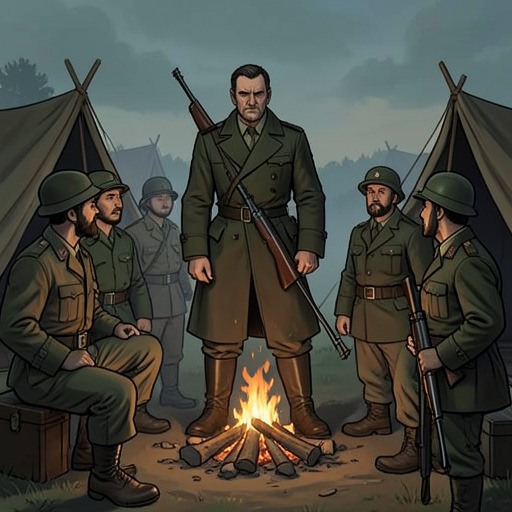
Pavel’s later letters from Siberia show that he has recognized the cost of leaving. He misses Lara and their daughter, and his letters from military school are depressed. After a few months he is commissioned lieutenant ahead of schedule and, unexpectedly, sent to the front. The journey takes him nowhere near Yuriatin, and his brief time in Moscow is too short for him to see anyone there.
His letters from the front are less despondent. He hopes to distinguish himself in action and earn leave, perhaps through a military exploit or a light wound, so that he can return to his family. When Brusilov’s forces break through and attack, however, his letters stop. Lara first attributes the silence to the movement of his regiment; as the advance slows and the troops dig in without any word from him, she begins making inquiries in Yuriatin, then by mail in Moscow and at his former field address. No one replies or seems to know what has happened.
Enlistment under the pressure of war
The enlistment’s consequences unfold within a war that repeatedly overwhelms ordinary life. A lieutenant Antipov is among the advance troops cut off and captured after Russian forces break through enemy positions but their supporting units fall behind. He has to surrender when his platoon does. His friend Galiullin, watching an attack through field glasses, mistakenly believes Antipov has been killed by a shell and buried in the explosion. The account of the assault makes clear how easily a comrade’s fate can disappear behind smoke and rumor: men run across an autumn field toward the trenches, fall under fire, and are obscured by the bursting shells.
At the mobile first-aid station, the war’s consequences arrive as wounded men jolting in unsprung ammunition carts, many unconscious after being picked up from the battlefield only half an hour earlier. In Moscow, a truck with two trailers brings wounded men to the hospital, where overcrowding has forced casualties into passages and onto landings. Later, a German breakthrough sets a village under fire and forces the hospital to move before an evacuation order arrives. Farther along the wartime upheaval, labor conscripts occupy eight cars at the back of a twenty-three-car train; there are about five hundred people of sharply different ages, occupations, and social circumstances. These scenes widen the meaning of Pavel’s enlistment: it separates a family, but it also draws him into a military system whose violence, displacement, and uncertainty reach soldiers, hospitals, and civilians alike.